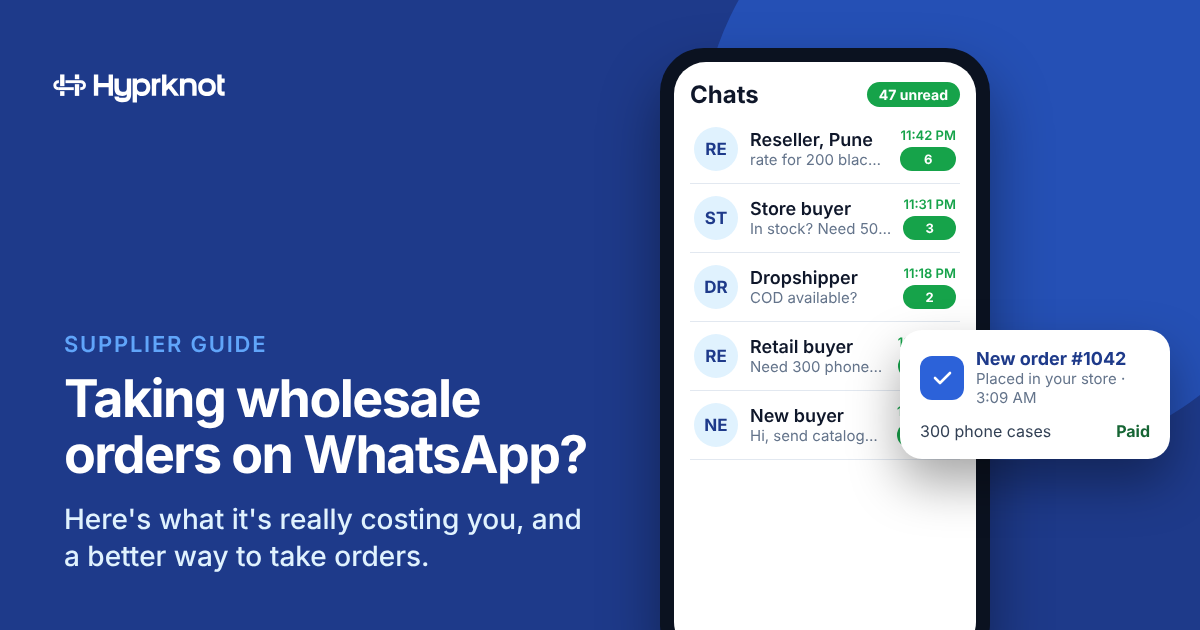
It's 10:40 at night and you've finally sat down to eat. Your phone lights up. A reseller wants 200 black tees in size L and asks if you can dispatch tomorrow. You'll reply after dinner.
Then another chat comes in. Then a voice note. Then someone asks "rate?" for the third time this week, about a product you priced for him on Monday.
When you get back to the first message it's 11:30, and he's gone quiet. In the morning he tells you, very politely, that he got it sorted elsewhere.
If you supply products to resellers, shops or dropshippers, you've had this night more than once. WhatsApp is where most of your business happens. It's also where a surprising amount of it slips away without you noticing.
This guide is about that slip. What it costs you, how to tell if you've outgrown taking orders in chat, and how to move to something better without losing the buyer relationships you've built over years.
Why WhatsApp became everyone's order book
Let's give it credit first. WhatsApp is free. Every buyer you have already uses it. You can send photos, price lists, voice notes and tracking links in one place, and it feels personal in a way an email never does.
When you have ten buyers, it works well. Honestly, it works well at thirty.
The trouble starts later. A chat app was built for conversations, not orders. There's no stock count, no order list, no record of who paid and who's on COD. All of that lives in your head, a notebook, or an Excel sheet that's out of date by lunchtime.
So the problem isn't WhatsApp. It's asking a chat app to do a job it was never designed for.
The real cost: work it out with your own numbers
Most suppliers we talk to have never put a number on this, so let's do it. The figures below are an example. Swap in your own.
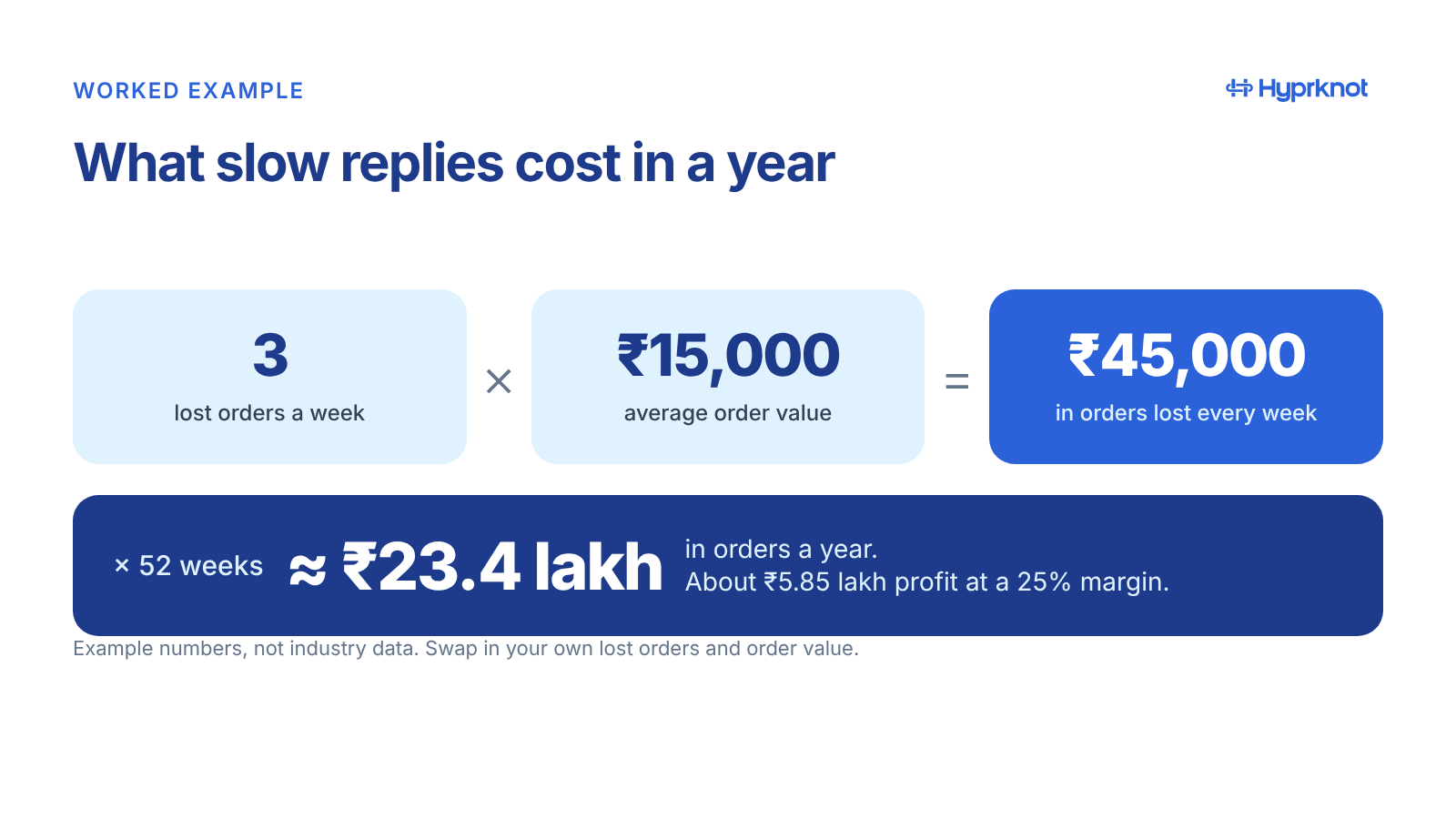
Say you lose 3 orders a week because a reply was slow, a message got buried, or the buyer messaged at night. Say your average order is ₹15,000.
- That's ₹45,000 a week.
- Over 52 weeks, it's about ₹23.4 lakh a year in orders that went to someone else.
That's revenue, not profit. If your margin is around 25%, you're still looking at roughly ₹5.85 lakh of profit walking out of your chats every year.
Then there's your time. If you spend three hours a day answering the same questions (price, stock, sizes, "COD available?"), that's about 90 hours a month. More than two full working weeks spent typing answers a product page could give.
Three lost orders a week is not a dramatic number, by the way. For a busy supplier it's probably low.
Five signs you've outgrown taking orders in chat
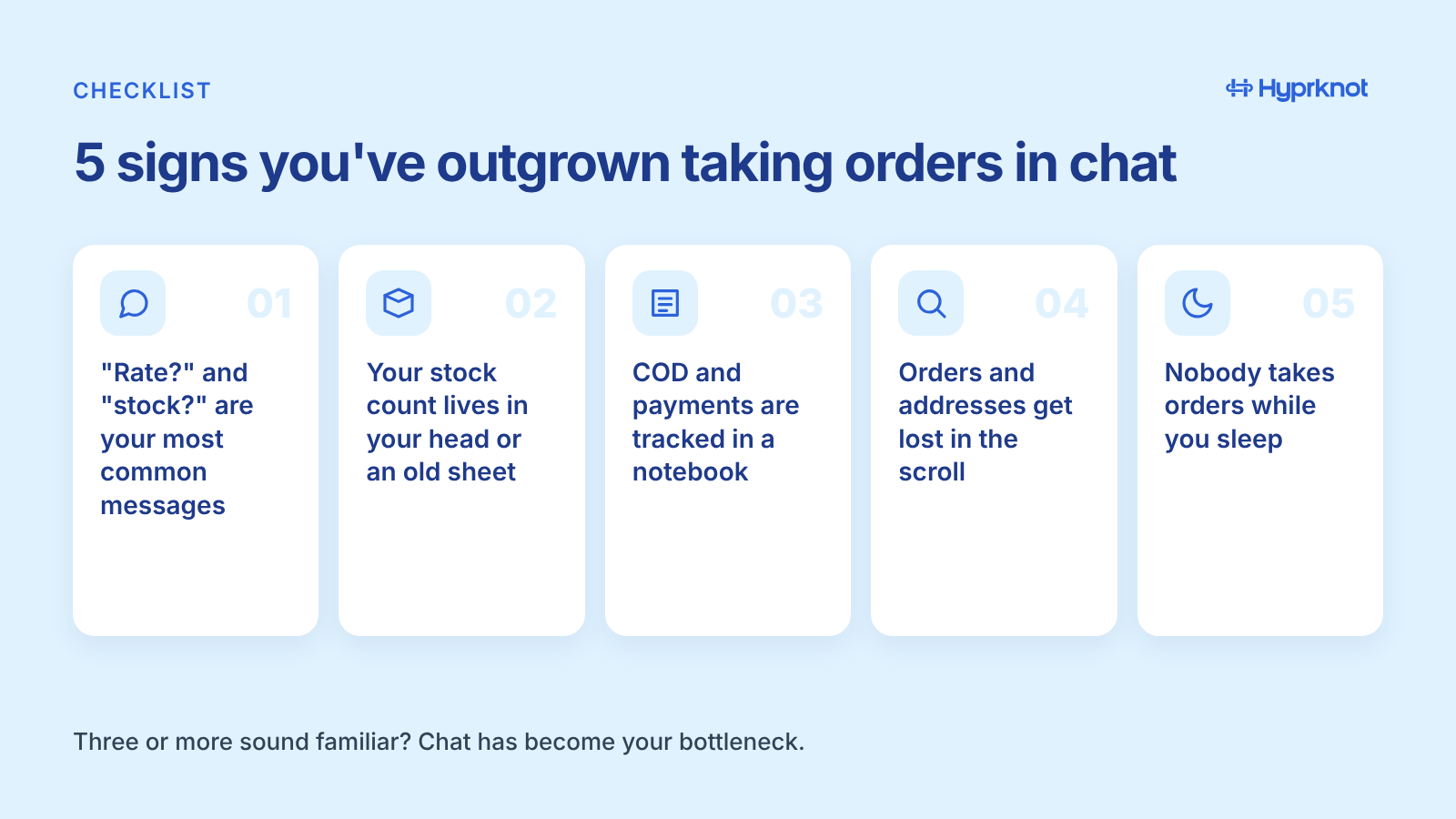
- "Rate?" and "stock?" are your most common messages. If you could auto-reply to just those two, you'd get your evenings back.
- Your stock count lives in your head. Or in a sheet nobody updated after yesterday's dispatch. You've promised stock you didn't have at least once.
- COD and payments are tracked in a notebook. Month end means scrolling through chats to work out who still owes you.
- Orders get lost in the scroll. You've had to dig three days back to find an address, or worse, sent a parcel to the wrong one.
- Nobody can take orders when you're asleep or away. Buyers in other cities, other time zones, or just night owls, all wait until you wake up. Some don't.
If three or more of these sound familiar, chat has stopped being your order book and started being your bottleneck.
Your options, compared honestly
There are four common routes. Each has a place. None of them is free of trade-offs.
1. WhatsApp Business with a catalogue. Free and familiar. The catalogue holds up to 500 items, you get up to 50 saved quick replies, and broadcast lists reach up to 256 people, but only people who have saved your number (respond.io). It's a real step up from plain chat. But buyers still have to message you to order, stock isn't live, and you still copy every order into your own records.
2. Chatbots and WhatsApp automation tools. These answer common questions instantly and can take simple orders. They're useful if your products are standard and your buyers are fine talking to a bot. They get clumsy with custom bulk orders, negotiated prices and mixed sizes, which is most of wholesale.
3. B2B marketplaces like IndiaMART. Good for finding new buyers. Paid seller plans on IndiaMART are listed from ₹40,000 a year (Mini Dynamic Catalog) up to ₹85,000 a year (Maximiser Pro), with a weekly quota of buyer leads (IndiaMART Help). What a marketplace doesn't fix is ordering from your existing buyers, and you're listed right next to your competitors.
4. Your own B2B ordering store. Buyers open your link, see your products, wholesale prices and live stock, and place the order themselves, any time. Orders, payments and COD land in one place. The trade-off is setup time, and buyers need a gentle push to switch from chatting to ordering.
| WhatsApp catalogue | Chatbot tools | B2B marketplace | Your own store | |
|---|---|---|---|---|
| Finds new buyers | No | No | Yes | Through your own marketing |
| Live stock for buyers | No | Sometimes | Varies | Yes |
| Takes orders while you sleep | No | Simple orders only | Leads, not orders | Yes |
| Order and COD records | Manual | Partial | Partial | Built in |
| Who owns the buyer relationship | You | You | Shared with the platform | You |
| Typical cost | Free | Monthly fee plus per-message charges | ₹40,000+ a year on IndiaMART's listed plans | Monthly subscription |
Many suppliers end up using two of these together: a marketplace to find new buyers, and their own store so those buyers can reorder without the back-and-forth.
How to move buyers to your own store without losing them
Here's the part most people get wrong. They try to move every buyer at once, or they tell buyers to "stop messaging on WhatsApp." Don't do either.
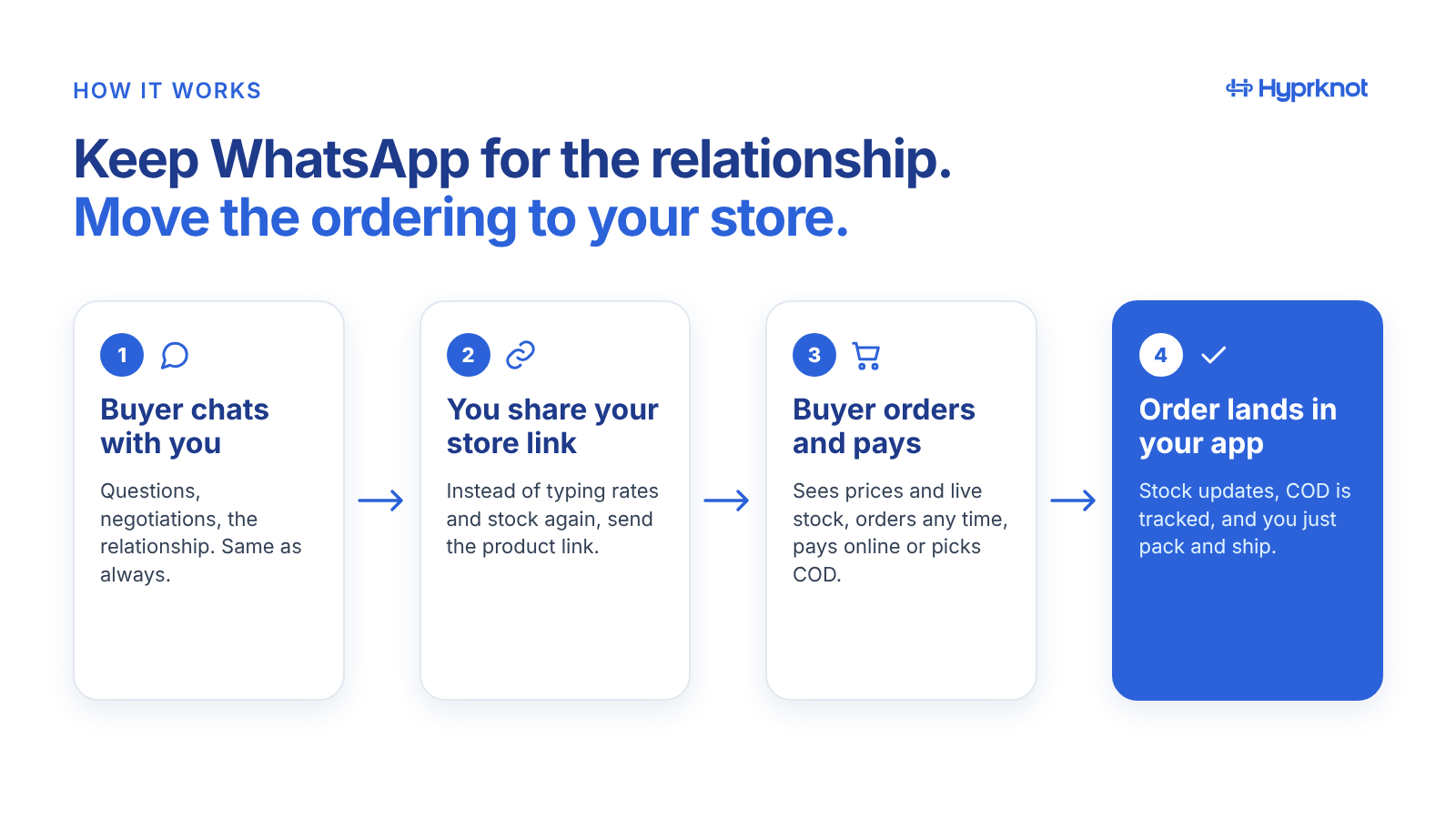
The idea is simple: keep WhatsApp for the relationship, move the ordering to your store.
Step 1: Start with your top 10 buyers. Not all 200. Pick the ones who order often and ask the same questions every time. They'll feel the difference fastest.
Step 2: Set up only what they actually buy. Products, wholesale prices, minimum order quantities and current stock. The photos you already send on WhatsApp are good enough to begin with.
Step 3: Send the link yourself, personally. Not a broadcast. Something like:
"Hi Ravi, quick one. Our full range, prices and live stock are now at shop.yourbrand.com. You can order there any time, even at night, and I'm still here on WhatsApp if you need anything."
Step 4: Answer "rate?" with the link, every time. Politely. "All current rates are on the store, here's the link for that product." After the third time, most buyers stop asking and start ordering.
Step 5: Make payment rules clear on the store. Show COD limits, advance payment terms and dispatch times upfront. Most "just confirming" messages disappear once these are written down.
Step 6: Check after two weeks. See which buyers now order on their own. Call the ones who don't and ask what's stopping them. Usually it's one missing product or one confusing step.
Done this way, buyers don't feel pushed out. They feel like you made their job easier, which you did.
What to look for in a B2B ordering platform
Before you pick a tool, check it against this list:
- Your brand, your link. Buyers should see your name, not a marketplace.
- Wholesale pricing. Bulk price tiers and minimum order quantities, not just a retail price.
- Live stock. Buyers see what's available, so you stop promising things you don't have.
- Payments into your own account. Online payments should go through your own payment gateway account, so the money reaches you directly.
- COD tracking. Who's paid, who hasn't, without a notebook.
- Shipping integrations. Book and track shipments from the same place you see orders.
- A phone-friendly app for you. You run your business from your phone, so your order tool should work there too.
- Pricing you can predict. A flat monthly fee is easier to plan around than a cut of every order.
This is exactly the problem we're building Hyprknot for. You get your own branded store for your buyers, and one app to manage orders, stock, clients and payments. Payments go straight to your own Razorpay, PayU or Cashfree account; we never hold your money. We're launching soon, and you can try a demo store today to see how ordering feels from your buyer's side.
FAQ
Can my buyers still message me on WhatsApp?
Yes, and they should. Keep WhatsApp for questions, negotiations and building the relationship. The store just takes over the repetitive part: browsing, checking stock and placing the order.
Do I need a website before I set up a B2B store?
No. A B2B ordering store can be your first online presence. You need product photos, prices and stock counts, which most suppliers already have in their WhatsApp chats.
Will my buyers actually use an online store?
Most will if it's quicker than chatting with you. Start with your regular buyers, send the link personally, and keep replying to "rate?" with the link. Expect it to take two to three weeks for ordering habits to change.
Is the WhatsApp Business catalogue enough?
For a small range and a handful of buyers, it can be. Once you need live stock, wholesale price tiers, COD records or orders while you're asleep, you'll outgrow it. The catalogue is a display, not an order system.
How do I handle COD for B2B orders?
Set clear rules (for example, COD up to a set order value, advance payment above it) and show them on your store. Use a tool that marks each COD order as paid or pending, so month-end isn't a hunt through chats.
Sources
- WhatsApp Business app limits (catalogue, quick replies, broadcast lists): respond.io, "WhatsApp Business App"
- IndiaMART paid seller plans and pricing: IndiaMART Help, "Paid services of IndiaMART"
- Cost figures in this article are a worked example, not industry data. Replace them with your own numbers.
Written by
Hyprknot Team
The people building Hyprknot: your own store for B2B buyers, and one app to run orders, stock, clients and payments.